We are a group of Artificial Intelligence researchers with specific interests in the automation and evaluation of creative processes in software. We pursue both practical applications and theoretical developments, in addition to engaging in philosophical discourse about the issues raised when consdering software which is meant to be autonomously creative.
|
|
Written by Michael Cook, ANGELINA is software we are using to investigate aspects of automated game design. We have been awarded an EPSRC grant entitled: Creative Code Generation for Interactive Media, and we will be investigating the possibility for creative software to generate and modify its own program code, by extending ANGELINA to generate code for videogames. Below are a couple of papers about ANGELINA, with more on Mike's webpages.
|
|
|
Funded by an EPSRC Fellowship, we aim to bring more formality to the assessment of creativity (and our perception of it) in software, and progress in general in Computational Creativity research. We have challenged foundational notions such as the usage of Turing-style tests, proposed new formalisms and raised various philosophical issues. The Fellowship also acts as an umbrella for all the projects in the group, in particular the FloWr and HR projects. |
|
|
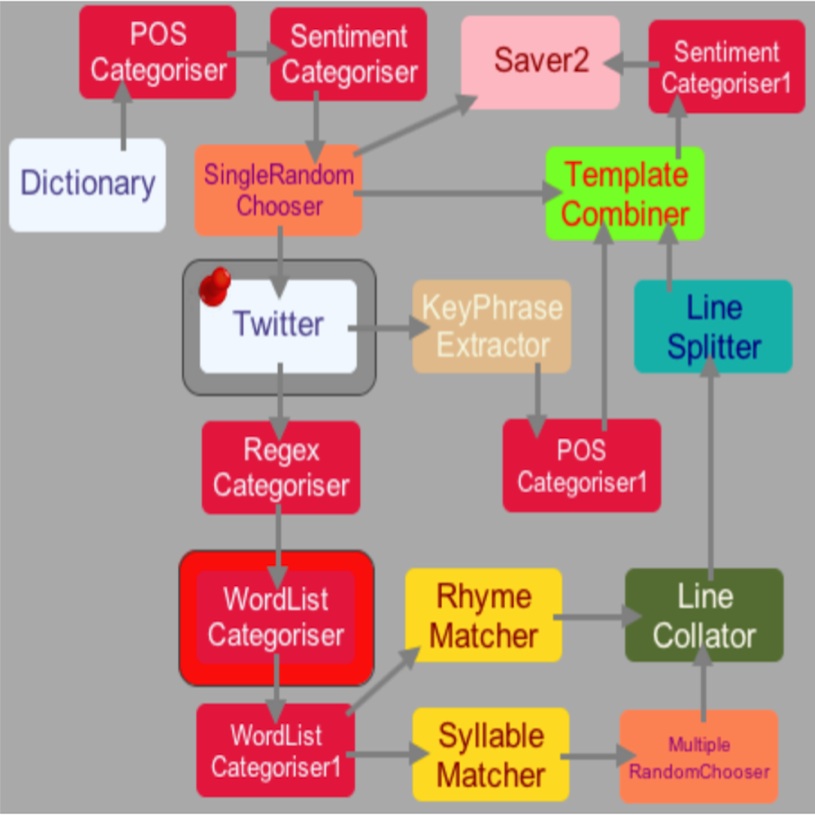
Under development by John Charnley, Simon Colton and Teresa Llano, the FloWr system is a general-purpose framework for building creative software. More than being a mere tool to enable people to develop generative software, the FloWr system itself will produce, test and improve upon new Flowcharts, ane we will use this as a platform for investigating automated process invention. We released the software to the Computational Creativity community in early 2014. Here is an extended abstract describing the approach:
|
|
|
We have always been fascinated by the processes at work in mathematical discovery, and in the potential for mathematical reasoning to solve Artificial Intelligence problems. We have developed a novel hybrid learning/reasoning approach called Automated Theory Formation, implemented it in the HR System, and applied this to many mathematical discovery and creative problem solving projects. There are dozens of papers about HR on the website, and this paper summarises it in machine learning terms, and summarises the achievements of the project:
|
|
|
Monte Carlo Tree Search (MCTS) is a method for making optimal
decisions in Artificial Intelligence problems, typically move planning
in combinatorial
games.
Cameron Browne
and Simon Colton
are investigating MCTS as part of the EPSRC project "UCT for Games and
Beyond" in collaboration with the universities of Essex and York. Our
particular interest in MCTS lies in its potential use as a creative
search algorithm for game design and other creative tasks.
|
|
|
We aim to build a software system called The Painting Fool, which is one day taken seriously as a creative artist in its own right. To achieve this, we are implementing AI, Vision, NLP and Graphics techniques to slowly hand over creative responsibility to the software. In addition, we regularly hold exhibitions of The Painting Fool's artwork in galleries, conferences and other events. We also engage with the public and researchers on philosophical issues raised by the project. There is much more information on The Painting Fool's own website.
|
|
|
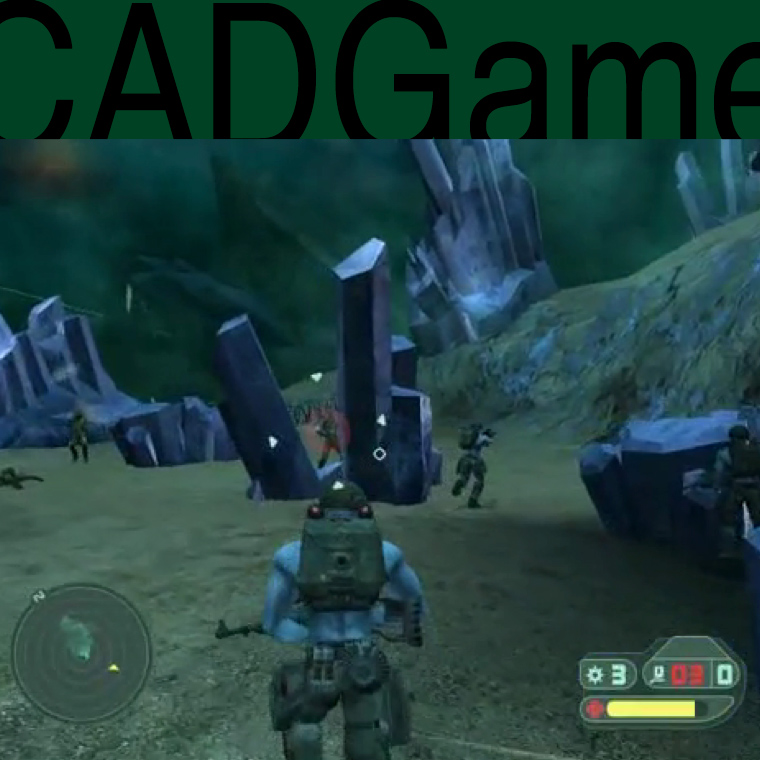
The CADGame project investigated new approaches to automatically modelling player behaviour and experience from gameplay data, to support human game designers and improved player-adaption in video games. We worked with partners at Rebellion Developments Ltd., a well known game design studio based in Oxford, on exploiting data capture in their design tools.
|
|
|
Robin Baumgarten developed an AI-Bot programming API for Introversion's strategy game DEFCON, which is a minimalist RTS game about nuclear war. The project page contains information about the API, an FAQ and tutorial, and example implementations. There was a IEEE Competition , and we also experimented in building AI-bots which competed successfully against Introversion's own automated opponent, as described in these papers:
|